

If you’ve started looking into web development, you’ve probably seen the terms frontend and backend. They’re the two main halves of most websites and web applications. Understanding the difference is one of the first useful things a beginner can learn.
This guide explains what each side does, how they work together, the skills involved, and how to decide which path might suit you better.
The Simple Analogy
Think of a restaurant.
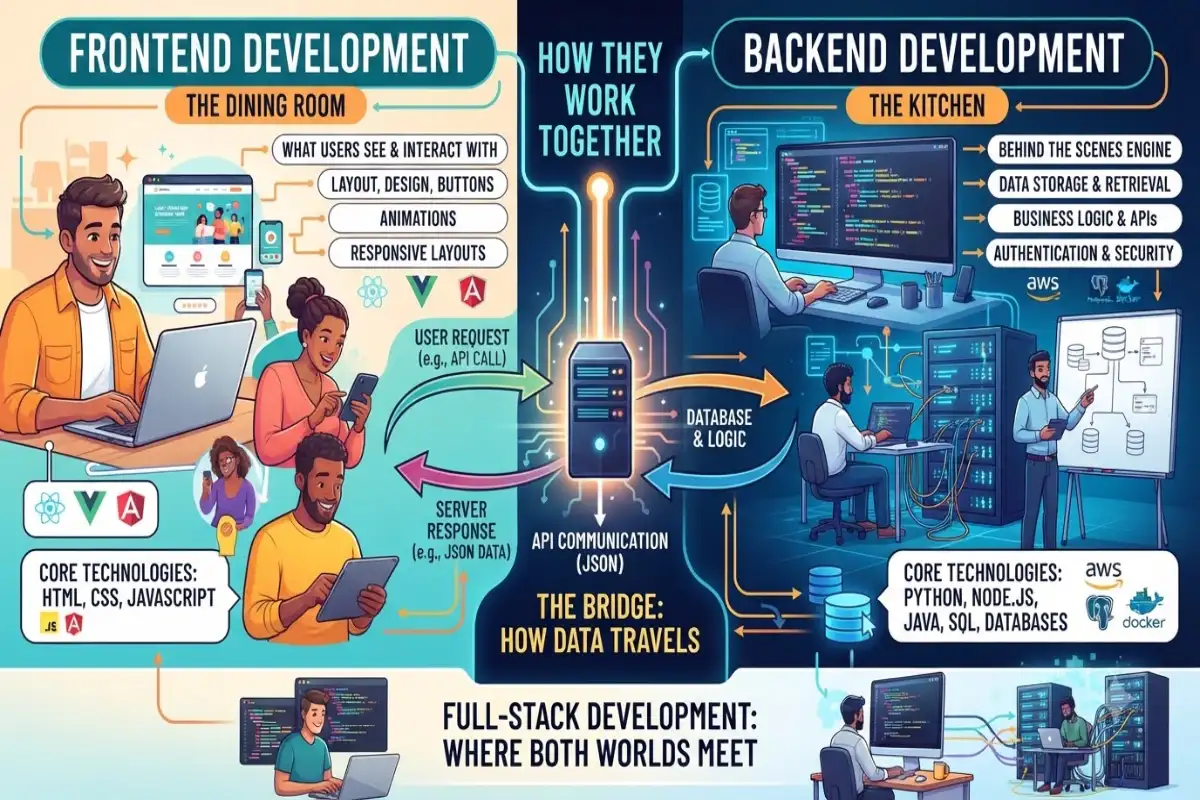
The frontend is the dining room — the tables, the menu, the lighting, the way the waiter takes your order and brings the food. It’s everything the customer sees and interacts with.
The backend is the kitchen — the chefs, the ingredients, the recipes, the order system, and the storage. Customers don’t see it, but without it the dining room can’t function.
Both parts have to work together. A beautiful dining room with a broken kitchen is useless. A great kitchen with no way for customers to place orders is also useless.
What Is Frontend Development?
Frontend development (also called client-side development) is everything that runs in the user’s browser.
When you visit a website, the frontend is responsible for:
- The layout and design
- Buttons, forms, and interactive elements
- Animations and transitions
- Making the site look good on phones, tablets, and desktops
- Showing data that comes from the server in a readable way
Core technologies:
- HTML — the structure (headings, paragraphs, forms)
- CSS — the styling (colors, fonts, spacing, responsive layouts)
- JavaScript — the behavior (what happens when you click something, dynamic updates)
Most frontend developers also use frameworks and libraries such as React, Vue, or Angular to build more complex interfaces faster. In 2026 these tools are still the standard for modern web apps.
Frontend work is very visual. You spend a lot of time thinking about user experience, accessibility, performance in the browser, and making sure things look consistent across different devices and browsers.
What Is Backend Development?
Backend development (server-side development) is everything that happens on the server, behind the scenes.
It handles:
- Storing and retrieving data (user accounts, posts, products, orders)
- Business logic (calculating prices, checking permissions, processing payments)
- Authentication and security (logging users in, protecting data)
- APIs that the frontend talks to
- Connecting to databases and other services
Common technologies:
- Programming languages like JavaScript (Node.js), Python, Java, C#, PHP, Ruby, or Go
- Databases such as PostgreSQL, MySQL, MongoDB
- Frameworks like Express, Django, Spring, Laravel, or ASP.NET
- Cloud services and servers (AWS, Azure, Google Cloud, etc.)
Backend developers worry about performance under load, data integrity, security, and reliability. If the backend is slow or goes down, the whole application suffers even if the frontend looks perfect.
How Frontend and Backend Work Together
Here’s a typical flow when you use a web app:
- You open the site in your browser → the frontend loads (HTML, CSS, JavaScript).
- You click a button or submit a form → the frontend sends a request to the backend (usually via an API).
- The backend processes the request, talks to the database if needed, and sends a response.
- The frontend receives the response and updates what you see on the screen.
They communicate mostly through APIs (Application Programming Interfaces). The frontend doesn’t need to know how the database is structured. The backend doesn’t need to know exactly how the buttons are styled. They just need to agree on the data format they exchange (often JSON).
Side-by-Side Comparison
| Aspect | Frontend | Backend |
| Where it runs | User’s browser | Server |
| Main focus | What the user sees and interacts with | Logic, data, and infrastructure |
| Core languages | HTML, CSS, JavaScript | Python, Java, Node.js, C#, PHP, Go, etc. |
| Key concerns | Design, usability, responsiveness, accessibility | Security, performance, data integrity, scalability |
| Tools & frameworks | React, Vue, Angular, Tailwind, etc. | Express, Django, Spring, databases, cloud tools |
| Visibility to users | Directly visible | Invisible to end users |
| Debugging style | Browser DevTools, visual checks | Logs, server monitoring, database queries |
| Typical “done” feeling | “It looks and feels right” | “It works reliably under load and is secure” |
Skills and Mindset Differences
Frontend developers often enjoy:
- Visual design and interaction
- Immediate feedback (you change code and see the result in the browser)
- Thinking about how real people will use the product
- Working closely with designers
They need a good eye for detail, patience with browser differences, and solid JavaScript skills.
Backend developers often enjoy:
- Problem-solving and logic
- Working with data and systems
- Thinking about edge cases, security, and scale
- Building things that stay reliable over time
They need stronger understanding of how servers, networks, and databases work, plus careful attention to security and performance.
Many people start on one side and later learn the other. Those who become comfortable with both are called full-stack developers.
Which One Should You Learn First?
For most complete beginners, frontend is the easier starting point:
- You can see results immediately in the browser
- Free learning resources are excellent and abundant
- You only need a code editor and a browser to begin
- It teaches core programming concepts through JavaScript
Once you understand how the frontend works and how it talks to APIs, learning backend becomes more concrete because you already know what the frontend needs from the server.
That said, if you love logic puzzles, data, and systems more than visual design, you might prefer starting with backend (often with Python or Node.js) and building simple APIs first.
Career and Day-to-Day Reality in 2026
Both roles remain in demand. Many job postings still separate “Frontend Developer” and “Backend Developer,” though full-stack roles are also very common, especially at smaller companies and startups.
Backend roles sometimes lean a bit more toward infrastructure, cloud, and system design as applications grow. Frontend roles have expanded into areas like design systems, performance optimization, and accessibility.
AI coding tools are used on both sides. They help generate components, suggest CSS, write boilerplate API code, or help with tests. They don’t remove the need to understand the fundamentals or review the output carefully.
Salaries vary by location, experience, and company, but both paths can lead to solid careers. Specialized skills (strong React + performance knowledge on the frontend, or distributed systems and database expertise on the backend) tend to command higher pay.
Common Misconceptions
- “Frontend is just making things pretty.”
Modern frontend involves complex state management, performance, accessibility, and architecture. - “Backend is only for advanced programmers.”
You can start with simple APIs and databases and grow from there. - “You have to choose one forever.”
Many developers move between the two or become full-stack over time. - “One is better than the other.”
They solve different problems. Good products need both done well.
Final Thoughts
Frontend is the part users see and touch. Backend is the engine that makes it all work. They depend on each other.
If you’re just starting, pick the side that feels more interesting to you right now and build small projects. A simple todo list with a nice interface teaches frontend. Connecting that same list to a real database teaches backend. Doing both teaches you how the pieces fit together.
Once you understand the difference and have built a few things on each side, you’ll have a much clearer picture of which direction you want to go deeper — or whether full-stack is the path that fits you best.
Also Read: Software
