

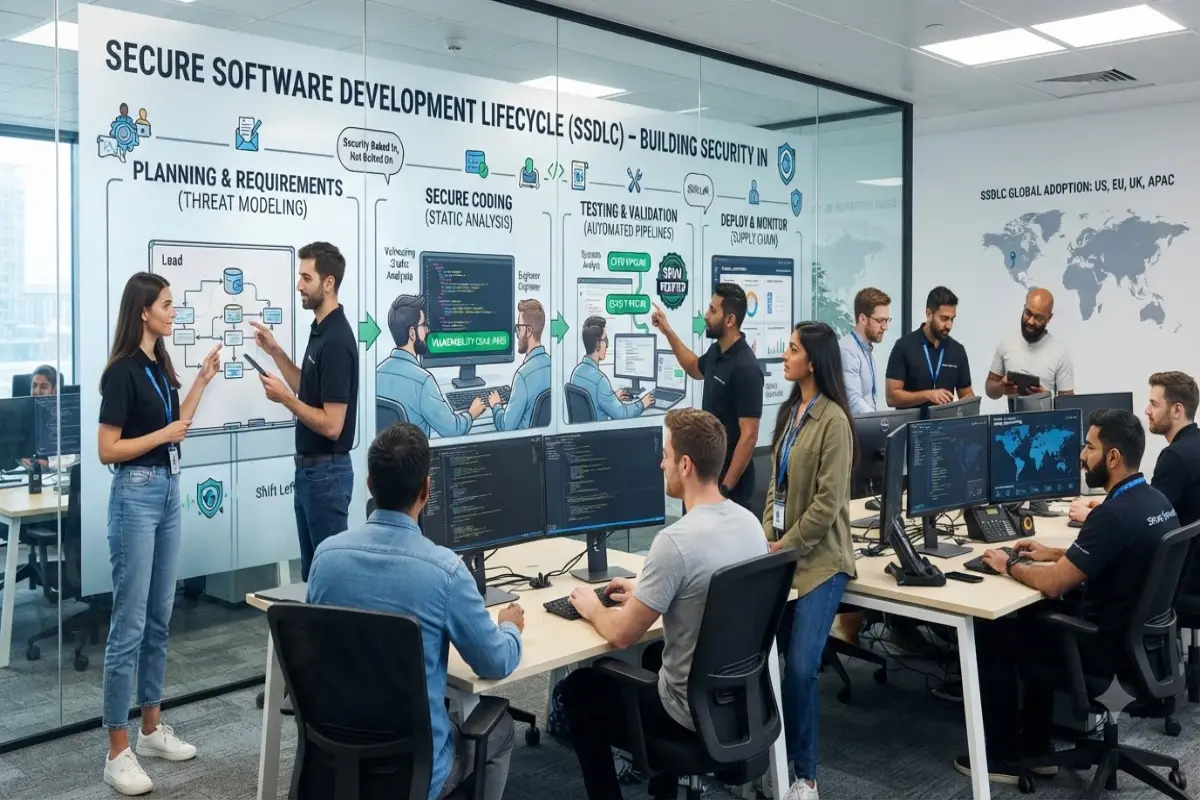
What Is Secure Software Development?
Secure Software Development is the practice of building software with security baked in from the very first idea, not bolted on at the end. Instead of writing code and then hunting for bugs, teams plan, design, code, test, and maintain software so that common attacks—like injection, broken authentication, or supply-chain compromises—become much harder to pull off.
Think of it like constructing a house. You do not finish the walls and roof and then try to add locks and strong foundations. You design the locks, the reinforced doors, and the alarm system into the blueprints. That is the core idea behind the Secure Software Development Lifecycle (SSDLC or Secure SDLC).
Why It Matters Right Now
Software runs almost everything—banking apps, hospital systems, cars, and government services. When a vulnerability slips through, the cost can be huge: data leaks, ransomware, or lost customer trust. Attackers now move faster, often using AI to find and exploit weaknesses in hours instead of weeks. At the same time, regulations are getting stricter, and customers expect products that are “secure by default.”
The main framework many organizations follow is NIST’s Secure Software Development Framework (SSDF). It groups practices into four simple areas:
- Prepare the organization – train people, set policies, and choose the right tools.
- Protect the software – keep source code and build systems safe from tampering.
- Produce well-secured software – write clean code, test early, and review dependencies.
- Respond to vulnerabilities – fix issues quickly and learn from them so the same mistake does not happen again.
Microsoft’s Security Development Lifecycle and OWASP guidelines follow similar ideas. The practical result is often called DevSecOps: security becomes everyone’s job, not just a separate security team’s problem at the end.
How the Process Works in Everyday Terms
- Requirements and planning – Ask “What could go wrong?” early. Identify sensitive data and decide how it must be protected.
- Design – Use threat modeling. Draw simple diagrams of how data flows and where an attacker might try to break in.
- Coding – Follow secure coding rules: validate every input, use parameterized queries, never hard-code secrets, and prefer memory-safe languages when possible.
- Testing – Run automated tools (static analysis, dependency scanning, dynamic testing) inside the normal build pipeline. Manual code reviews and penetration tests still matter for complex parts.
- Deployment and maintenance – Ship with secure defaults, keep an inventory of every component (often called an SBOM), and have a clear process for patching.
Modern teams also watch the supply chain carefully. Most applications contain large amounts of third-party open-source code. One compromised library can affect thousands of products.
Country-Wise Comparison of Approaches (as of 2026)
| Country / Region | Key Framework or Law | Main Focus | Enforcement Style |
| United States | NIST SSDF, CISA guidance | Voluntary best practices + contract requirements | Agency-by-agency; attestation rules eased in 2026 |
| European Union | Cyber Resilience Act (CRA) | Product security, vulnerability reporting within 24 hours | Mandatory CE marking and liability from late 2027 |
| United Kingdom | NCSC Software Security Code of Practice | Secure design, build environment, customer communication | Guidance with strong industry expectation |
| Australia | Information Security Manual + Secure by Design | Secure by default, memory-safe languages preferred | Government systems mandatory; industry encouraged |
| China | Amended Cybersecurity Law (2026) | Product certification and supply-chain control | Strict penalties, focus on critical infrastructure |
| Japan / Singapore / Canada | National guidance aligned with NIST + SBOM | Supply-chain transparency and secure development | Mix of procurement rules and voluntary standards |
North America still leads in tool adoption and market size, while Asia-Pacific is growing fastest because of rapid digitalization and new compliance rules.
Year-Wise Snapshot of Growth and Change
| Year | Notable Development | Approximate Market Trend |
| 2023–2024 | Rise of SBOM requirements and “shift-left” security | Steady growth in DevSecOps tools |
| 2025 | AI coding assistants become common; supply-chain attacks increase | SSDLC-related market around $6–7 billion range |
| 2026 | EU CRA reporting clocks start; AI-generated code raises new risks | Strong double-digit growth; focus on agent security and automated testing |
| 2027–2030 | Full CRA application in EU; wider post-quantum crypto planning | Continued expansion as security becomes a standard release gate |
These numbers come from industry analyses of related markets such as DevSecOps platforms, application security testing, and secure development tools. Exact figures vary by source, but the direction is clear: spending and attention keep rising.
Practical Best Practices Teams Use Today
- Treat security requirements as normal product requirements.
- Automate as much checking as possible inside CI/CD pipelines.
- Keep development, test, and production environments strictly separated.
- Require multi-factor authentication for anyone who can change code or pipelines.
- Maintain an up-to-date software bill of materials so you know exactly what is inside every release.
- Train developers regularly and make secure coding the default, not an extra step.
- Plan for AI-generated code: review it the same way (or more carefully) than human-written code.
Looking Ahead
In 2026 the biggest new pressure is AI. Code is being written faster than ever, sometimes by agents with little human oversight. That speed creates opportunity and risk at the same time. Teams that already practice secure development are better placed to add extra checks for AI-generated parts. Regulations will keep pushing for transparency and faster vulnerability handling. Countries are still aligning on common ideas such as SBOMs, but the details of laws differ.
Secure software development is not a one-time project or a special tool you buy. It is a set of habits and processes that become part of how software is made. When done well, it reduces the number of serious vulnerabilities that reach users, lowers the cost of fixing problems later, and builds trust. The organizations that treat security as a normal part of quality—rather than an afterthought—will be the ones that stay ahead as threats and regulations continue to evolve.
The good news is that the basic principles are straightforward and have been proven over years of practice. Start with clear requirements, design with threats in mind, write careful code, test early and often, and keep improving. That is secure software development in plain terms.
