

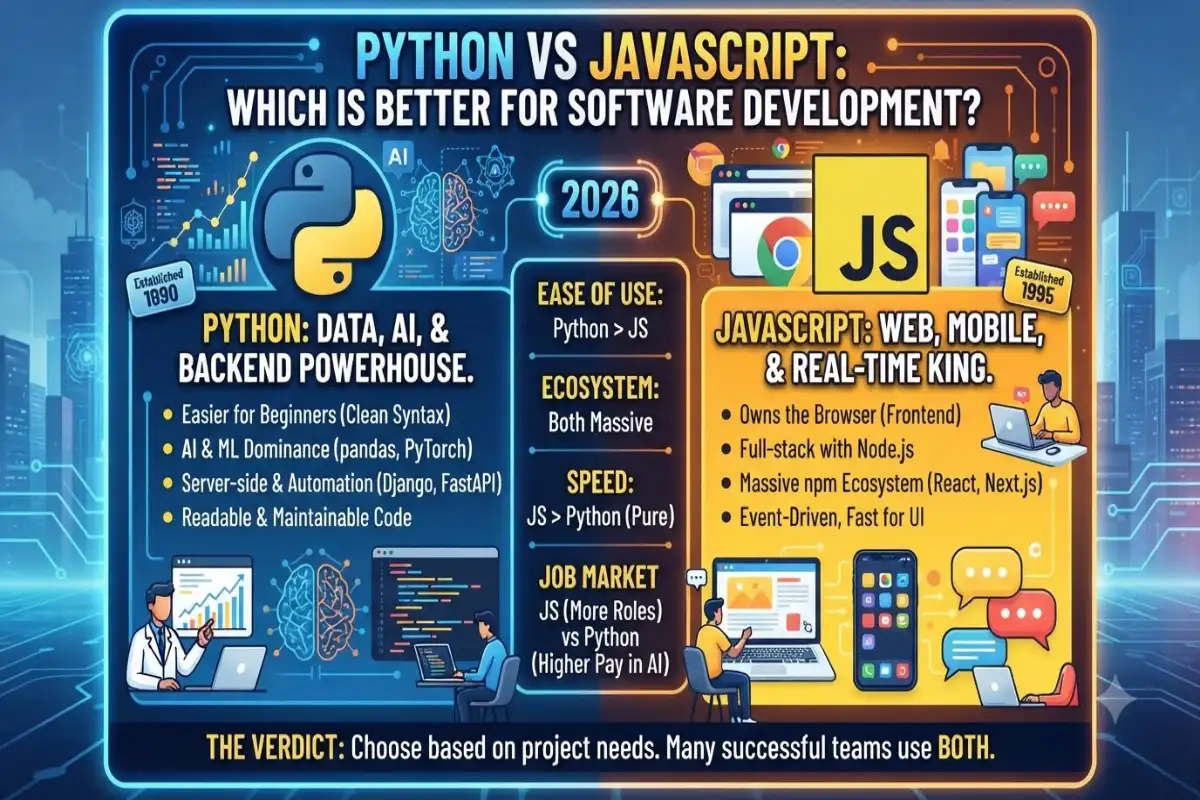
A lot of people still fight over this question. Some say Python software is the future because of AI. Others say JavaScript is king because almost every website needs it. The truth is less dramatic. Both languages are strong in 2026. They just win in different places.
I have worked with both over the years. Python feels calm and clear. JavaScript feels fast and flexible, sometimes a bit messy. Neither is perfect. The better one depends on what you want to build and where you want to work.
A Quick Look at Both Languages
Python came out in the early 1990s. The goal was simple code that people could read easily. You use spaces for structure instead of lots of brackets. It feels closer to normal English than most languages. That is why many schools and beginners start with it.
JavaScript started in 1995 for web browsers. It had to work fast inside Netscape. The language grew a lot after that. Now it runs in browsers, on servers with Node.js, on phones with React Native, and even on desktop apps. TypeScript, which adds types to JavaScript, has become very common for bigger projects.
In recent surveys, more professional developers still use JavaScript every day. Numbers from the 2025 Stack Overflow survey put it around 66 to 69 percent. Python sits lower, near 55 percent, but it grew faster than most languages in the last couple of years. On the TIOBE index, which tracks search interest, Python stays at number one. Different rankings measure different things, so both languages look healthy.
Side-by-Side Comparison
Here is a simple table based on how things stand in 2026:
| Point | Python | JavaScript |
| Main strength | Data, AI, automation, backend | Web frontends, full-stack, mobile |
| Ease for beginners | Easier, cleaner syntax | Medium, some confusing parts early |
| Speed | Slower for pure code, fast with C libraries | Faster with modern engines |
| Package ecosystem | Very strong for data and science | Huge for web tools and UI |
| Runs in browser | No | Yes |
| Good for AI / ML | Excellent | Limited |
| Full-stack possible | Backend only | Yes, with Node.js |
| Job volume | High, growing fast in AI roles | Highest overall |
| Average pay feel | Slightly higher in specialized AI jobs | Strong across web roles |
The table is a summary, not a full story. Real projects often mix both languages.
Where Python Does Better
Python shines when the work involves data or smart systems. If you need to clean large files, train a model, build a recommendation engine, or write scripts that connect different tools, Python is usually the easier path. Libraries like pandas, NumPy, PyTorch, and scikit-learn are mature and widely used. Most research papers and tutorials in machine learning still use Python.
Backend work is also solid. Frameworks such as Django, Flask, and FastAPI let you build APIs quickly. FastAPI especially has grown popular because it is fast to write and comes with good documentation tools. For automation and DevOps scripts, Python remains a favorite. Many teams use it to manage servers, process files, or handle daily tasks.
The code itself is easy to read later. When a new person joins the team, they can often understand Python code without too much struggle. That matters on long projects.
Where JavaScript Does Better
JavaScript owns the browser. Nothing else runs natively there. If users need to click buttons, see live updates, or use a smooth interface, you need JavaScript or something that turns into it. Frameworks like React, Vue, and Svelte, plus full tools like Next.js, power most modern websites.
Because of Node.js, the same language can also run on the server. Many teams like this. One language for the whole product means less switching in your head and easier hiring sometimes. React Native lets people build mobile apps with the same skills. Electron does similar work for desktop programs.
JavaScript is also strong for real-time features. Chat apps, live dashboards, and games that update constantly often use Node.js because it handles many connections at once without heavy work.
The package system on npm is massive. You can find a tool for almost any web-related task. The downside is that the ecosystem moves fast and can feel noisy. New tools appear often, and older ones get left behind.
Performance in Real Life
On pure speed tests, JavaScript usually wins. Modern engines turn the code into fast machine instructions. Python’s main version is slower for heavy number work done only in Python. But most serious Python data work does not stay in pure Python. It calls fast libraries written in C or other languages. So for machine learning training or big data jobs, the difference shrinks a lot.
For normal web APIs, both are fine for most companies. The database, network, or how the code is written usually matters more than the language. I have seen slow Python services and slow Node services. Good design beats language choice most of the time.
Python still has the old Global Interpreter Lock issue for some multi-core work, though recent versions have improved this. Node.js is strong at handling many waiting connections at the same time.
Jobs, Money, and Learning Path
Both languages have good job markets. JavaScript has more total openings because websites are everywhere. Frontend, full-stack, and Node roles stay common. Python has grown fast in AI, data science, and automation jobs. Those specialized roles often pay a bit more at the higher levels.
Salaries depend more on experience and location than on the language alone. A strong senior developer in either can earn well. Entry-level work exists in both, though competition is real.
If you are new and not sure what you want, start with Python. The simple style helps you learn the basic ideas of programming without extra confusion. Once those ideas feel clear, learning JavaScript is manageable.
If you already know you want to build websites or apps people can see and click, start with JavaScript and learn TypeScript early. You will see results in the browser quickly, which helps motivation.
Most people who stay in the field end up touching both at some point. The ideas transfer. Syntax is only surface level.
How Teams Actually Use Them
In many real products today the stack is mixed. The backend that handles data or runs models is often Python. The part users see and interact with is JavaScript or TypeScript. They talk to each other through APIs. This setup is common because each language does what it does best.
Some startups prefer one language for everything and choose the JavaScript side. Some data-heavy companies stay mostly in Python and add a thin JavaScript layer only where needed. Both approaches work when the team knows the tools.
Final Thoughts
There is no single winner. Python is better when the job is about data, models, clear logic, or automation. JavaScript is better when the job is about interfaces, browsers, or keeping the full product in one language.
Ask yourself a few simple questions. Do you want to work with AI or data? Lean Python. Do you want to build websites and apps people use every day? Lean JavaScript. Do you want the most job options right now? Both are fine, but JavaScript still has the wider net while Python is growing faster in high-interest areas.
The best developers I know do not treat languages like sports teams. They pick the tool that fits the problem and move on. Both Python and JavaScript are mature, well-supported, and capable of serious work in 2026. Choose the one that matches the projects you care about, learn it properly, and keep improving. That matters more than winning an online argument.
