

Type “IT managed services near me” into a search bar and you’ll get a tidy list of pins on a map, ranked as if proximity were a proxy for competence. It isn’t, and I’d argue it never really was. A company two kilometres away can be slower to answer the phone than one working entirely remote. A search for IT managed services near me tells you almost nothing about who’ll actually pick up when your systems go down at 4:45 on a Friday, and that’s the question that actually matters.
The “near me” instinct comes from an older, reasonable idea: local means accountable, means someone will show up. That idea made more sense when IT support meant a technician physically hunched over a server in your closet. Most of what modern managed services actually do, monitoring, patching, backups, cloud administration, security oversight, happens over a network connection, not a windshield. Distance is close to irrelevant to whether any of that gets done well. What matters is whether it gets done at all, consistently, and how fast someone responds when it doesn’t.
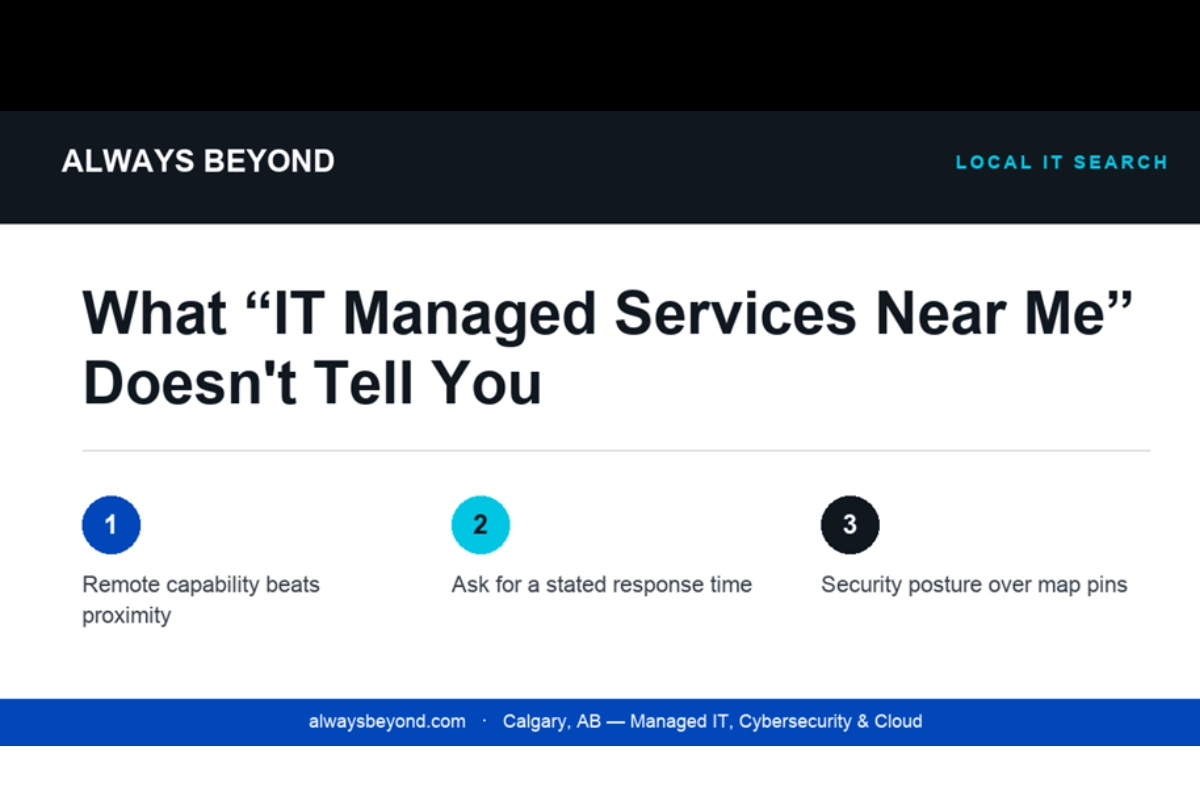
So if proximity is the wrong filter, what should replace it? Start with remote capability, because it’s the thing “near me” search results actively obscure. A provider that can monitor, patch, and resolve most issues without driving anywhere isn’t cutting corners, it’s usually faster than one that has to load a van and fight traffic. Ask directly: what percentage of issues get resolved without an on-site visit, and how is that measured? A confident, specific answer beats a reassuring shrug every time.
Response time is the second thing worth demanding in actual numbers, not adjectives. “Quick,” “fast,” and “responsive” appear on every provider’s website regardless of what actually happens when you call. A stated response time, something concrete like answering the phone in under 90 seconds, is a claim that can be checked and held against later. If a provider won’t commit to a number, that’s the answer, they haven’t measured it, which usually means it isn’t good.
Security posture matters more than a map pin ever will, and it’s the category “near me” results are worst at surfacing. A provider physically down the street with no real alignment to a recognized security framework, no meaningful patch cadence, and no answer for what happens after a breach is a worse bet than one three provinces away that takes CIS Controls alignment seriously and can describe, specifically, what it does when something goes wrong. Ask what framework guides their security work. If the answer is vague, that’s informative too.
It’s also worth asking what a provider actually stands behind, not just what they claim to prevent. Plenty of companies will tell you they take security seriously. Fewer will put anything resembling a real guarantee behind that promise, something with teeth if the worst happens anyway. A vague assurance costs a provider nothing to say. A stated commitment, in writing, costs them something if they’re wrong, and that difference is a far better signal than a short commute.
Real availability is the last piece, and it’s different from advertised hours. Plenty of providers list business hours on their site and mean something closer to “when it’s convenient.” Ask what actually happens at 2 a.m. on a Sunday when a server goes down: is there a real answer, or does the promise quietly stop the moment it’s inconvenient? A provider that’s honest about the limits of its coverage is more trustworthy than one that claims to cover everything and hopes you never test it.
None of this means location is worthless. There’s still something to be said for a provider who understands the local business landscape, who’s dealt with the same internet providers and the same regional quirks you have. But that’s a secondary consideration, not the primary filter, and it’s certainly not something a map pin can measure. Being employee-owned and physically based in Calgary happens to matter to Always Beyond, but it’s not the reason to hire anyone.
Next time that search bar returns a list of nearby names, skip the ranking and start asking the questions the map can’t answer. Proximity tells you how long a drive might take. It tells you nothing about whether anyone will actually answer the phone, and that’s the only distance that matters when something breaks.
