

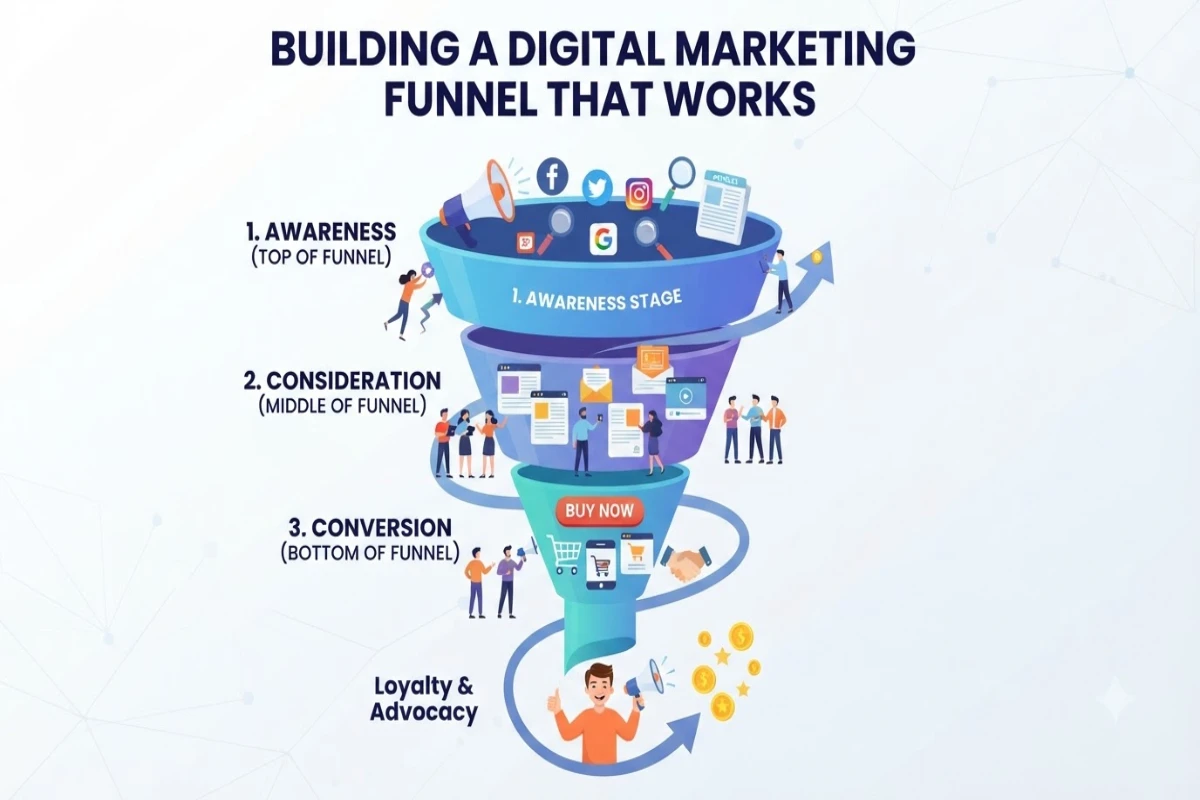
Most businesses throw money at ads and content without a clear path. People visit the site, look around, then leave. A digital marketing funnel fixes that. It is simply a way to guide strangers from “who are you?” to “take my money” and even to “I’ll tell my friends.”
Think of it like a real funnel. Wide at the top. Narrow at the bottom. Lots of people enter. Fewer move forward. Your job is to make the journey smooth so more people reach the end.
In 2025 and 2026 the funnel still works, even with AI search and short attention spans. Buyers still move through stages. They just bounce around more. Your funnel needs to meet them where they are.
What Is a Digital Marketing Funnel?
A digital marketing funnel maps the steps a person takes before buying. Classic model has three main parts:
- Top of Funnel (TOFU) – Awareness
- Middle of Funnel (MOFU) – Consideration
- Bottom of Funnel (BOFU) – Decision
Some add loyalty or advocacy after the sale. That is smart because happy customers bring new ones.
Here is a simple table showing what each stage needs:
| Stage | Buyer’s Mindset | Main Goal | Content & Tactics Examples | Key Metrics |
| TOFU (Awareness) | “I have a problem but don’t know solutions yet” | Get noticed and build trust | Blog posts, short videos, social posts, SEO content, podcasts | Website traffic, new visitors, social reach |
| MOFU (Consideration) | “What are my options? Which one fits me?” | Educate and capture leads | Case studies, webinars, email sequences, comparison guides, free tools | Email sign-ups, lead magnet downloads, time on site |
| BOFU (Decision) | “Should I buy this one?” | Remove doubts and close the sale | Free trials, demos, pricing pages, testimonials, limited offers | Conversion rate, demo bookings, sales |
This table is based on what works right now across many industries. Numbers vary, but the idea stays the same.
Step 1: Know Exactly Who You Are Talking To
You cannot build a good funnel for “everyone.” Start with your ideal customer.
Write down:
- Age, job, location if it matters
- Main problems they face
- What they search for online
- What almost stops them from buying
Talk to real customers if you can. Ask how they found you and what made them choose you. This research is the foundation. Skip it and the rest falls apart.
Step 2: Map the Real Customer Journey
People do not move in a straight line anymore. Someone might see your Instagram ad, then Google a question, then read a competitor’s review, then come back to your email.
Write the typical path:
- How do they first hear about the problem?
- Where do they look for answers?
- What questions come up next?
- What finally pushes them to buy?
Your funnel content should answer those questions in order.
Step 3: Create Content for Each Stage
This is where most people go wrong. They make sales pages for people who just discovered them. Or they keep posting random blogs with no next step.
Top of Funnel content
Help first. Do not sell. Write guides that solve small problems. Make short videos that show common mistakes. Use SEO so people find you when they search. Social media works well here too. Goal is simple: get them to know your name and feel you understand them.
Middle of Funnel content
Now they know they have a problem. Show how you solve it better than others. Case studies work great. Webinars. Free checklists or templates in exchange for email. Email sequences that nurture without being pushy. Build trust here. Most leads die because no one follows up properly. Data shows around 79% of leads never convert simply because of weak nurturing.
Bottom of Funnel content
Make buying easy. Clear pricing. Strong testimonials. Free trials or demos. Limited-time offers if it fits your business. Answer every possible objection. Remove friction. One extra form field can kill conversions.
Step 4: Choose the Right Channels
Not every channel fits every stage.
- TOFU: SEO, organic social, YouTube, paid social for reach
- MOFU: Email, LinkedIn (especially B2B), retargeting ads, webinars
- BOFU: Google Ads for high-intent searches, sales pages, chat, phone
Track where people come from. SEO often brings higher quality leads than pure paid ads. Recent numbers show SEO leads convert better at later stages.
Step 5: Set Up Tracking and Automation
You need to see what works. Use free tools like Google Analytics and a simple CRM. Set up:
- Landing pages with clear call-to-actions
- Email sequences that start automatically
- Lead scoring so sales knows who is ready
Without tracking you are guessing. With tracking you can fix the leaks.
Step 6: Measure, Test, Improve
Look at the numbers regularly.
Common benchmarks (these move by industry):
- Visitor to lead: often 1–3%
- Lead to marketing qualified: around 25–40%
- Marketing qualified to sales ready: 13–30%
- Overall lead to customer: 2–5% in many B2B cases
If people drop off at one stage, fix that stage first. Small improvements at the bottom of the funnel often make more money than big traffic increases at the top.
Test headlines, offers, email subject lines. Change one thing at a time. Keep what works.
Common Mistakes That Kill Funnels
- Selling too early
- No clear next step after content
- Ignoring mobile users
- Not following up with leads
- Treating every visitor the same
Also, remember the journey is not always linear. Some people jump stages. Your content should still help them wherever they land.
After the Sale: Keep Them Coming Back
A good funnel does not stop at the purchase. Send useful emails. Ask for reviews. Create loyalty programs or referral offers. Happy customers become your cheapest marketing channel.
Final Thoughts
Building a digital marketing funnel is not complicated. It takes some planning and consistent work. Start with knowing your customer. Create helpful content for each stage. Capture leads. Nurture them. Make the final step easy. Track everything and fix the weak spots.
Do this and you stop hoping people will buy. You guide them there step by step. The businesses that do this well grow steadier and spend less money chasing cold traffic.
Start small. Map one customer journey this week. Create one piece of content for each stage. Set up a simple email sequence. You will already be ahead of most competitors who still just post and pray.
