

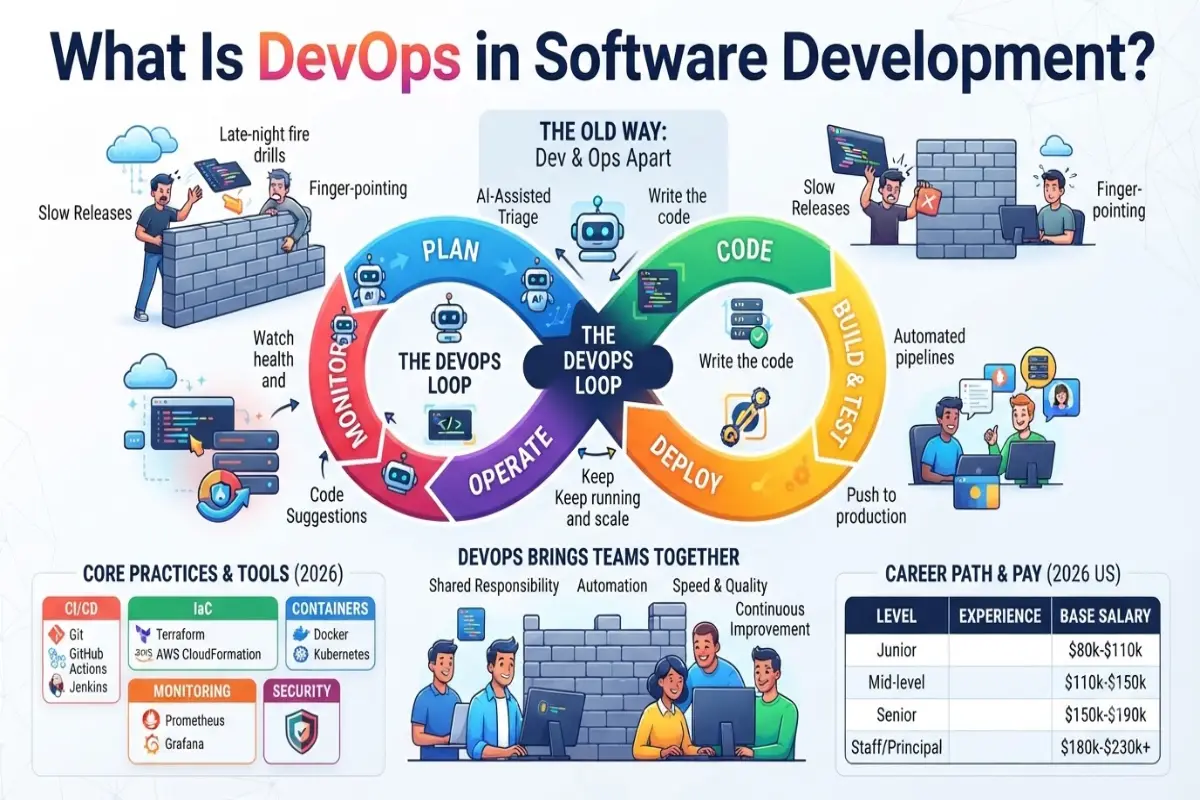
DevOps is the practice of getting the people who write software and the people who keep it running to work as one team. The word itself is just Development plus Operations. Instead of developers finishing code and tossing it over a wall to the ops crew, everyone shares responsibility from the first line of code to the live system that users actually use.
In the old way, developers focused on new features while operations worried about uptime and servers. That split often meant slow releases, late-night fire drills, and finger-pointing when something broke. DevOps removes that wall. Teams automate the boring, error-prone steps, measure what actually matters, and keep improving. The goal is simple: ship useful software faster and with fewer surprises.
How it actually works
A typical DevOps loop looks like this: plan a small change, write the code, build it automatically, run tests, release it, deploy it to production, watch how it behaves, and use that feedback to plan the next change. Nothing stays manual if it can be automated. Code gets merged several times a day. Tests run on every change. Infrastructure is described in files the same way application code is, so servers can be created or rebuilt with a single command.
The cultural side is just as important. Teams practice blameless post-mortems—when something goes wrong the question is “how do we stop this kind of failure?” not “who messed up?” Shared ownership means the people who built a feature also help keep it healthy in production.
Core practices that make the difference
Continuous Integration and Continuous Delivery (CI/CD)
Developers push small code changes often. Automated pipelines build the software, run tests, and prepare it for release. Continuous Delivery means the software is always in a state where it can go live with one click or even automatically.
Infrastructure as Code
Instead of clicking through cloud consoles, you write files that describe servers, networks, and databases. Tools like Terraform or OpenTofu turn those files into real infrastructure. Everything is versioned, reviewable, and repeatable.
Containers and orchestration
Docker packages an application and everything it needs into a container. Kubernetes then runs and scales those containers across machines so the app stays available even when traffic spikes or a server dies.
Monitoring and observability
You do not just wait for users to complain. Tools collect metrics, logs, and traces so the team can see problems early and fix them before most people notice.
Security built in (DevSecOps)
Security checks happen automatically during the build, not weeks later. Scanning for vulnerabilities in code and containers becomes part of the normal pipeline.
Here is a quick view of the main stages and common tools in 2026:
| Stage | What happens | Popular tools |
|---|---|---|
| Plan | Decide what to build | Jira, Linear, GitHub Issues |
| Code | Write and review | Git, GitHub, VS Code |
| Build & Test | Compile, run automated tests | GitHub Actions, GitLab CI, Jenkins |
| Deploy | Push to production safely | Argo CD, Flux, Kubernetes |
| Operate | Keep it running and scale | Docker, Kubernetes, Terraform |
| Monitor | Watch health and performance | Prometheus, Grafana, Datadog, OpenTelemetry |
Skills that employers look for right now
You do not need to know every tool. The ones that show up most often in job posts are:
- CI/CD pipelines (GitHub Actions is the everyday default for many teams)
- Kubernetes and Docker
- At least one major cloud (AWS still leads, followed by Azure and Google Cloud)
- Infrastructure as Code, especially Terraform or OpenTofu
- Scripting in Python or Bash
- Basic monitoring and logging
- Linux fundamentals
Soft skills matter too: clear communication, comfort with on-call rotations, and the habit of writing things down so the next person can understand what you did.
Career path and pay in 2026
DevOps roles remain well paid because the work sits right in the middle of speed and reliability. Typical U.S. base ranges look roughly like this:
| Level | Experience | Approximate base salary |
|---|---|---|
| Junior / Entry | 0–2 years | $80k–$110k |
| Mid-level | 3–6 years | $110k–$150k |
| Senior | 7+ years | $150k–$190k |
| Staff / Principal | 10+ years | $180k–$230k+ |
Total compensation at larger tech companies can climb higher once equity and bonuses are added. Related titles such as Site Reliability Engineer (SRE) or Platform Engineer often sit a bit above pure DevOps roles because they focus more on reliability or on building internal tools that make other developers faster.
Many people start as system administrators or developers and then move into DevOps. Others come through focused training paths that cover Linux, containers, cloud, and automation. Certifications like AWS DevOps Engineer or Certified Kubernetes Administrator can help open doors, but real projects and production experience count more.
What is changing in 2026
AI is now part of the daily toolkit. Pipelines can suggest fixes for failing builds, generate infrastructure code, and help triage alerts. Platform engineering has grown: instead of every team inventing its own deployment process, a central platform team builds shared tools so developers can ship safely without becoming infrastructure experts. GitOps—treating the desired state of the system as code in Git—has become common for Kubernetes environments.
Elite teams still deploy multiple times a day with very short lead times from commit to production and recover from problems in under an hour. That gap between high performers and everyone else is still large, which is why organizations keep investing in these practices.
DevOps is not a job title you can simply buy or a tool you can install. It is a way of working that treats the whole path from idea to live service as one continuous loop. When it works, software reaches users sooner, problems get fixed faster, and the people building the product stay closer to the people using it. That combination keeps the approach relevant even as new technologies appear.
