

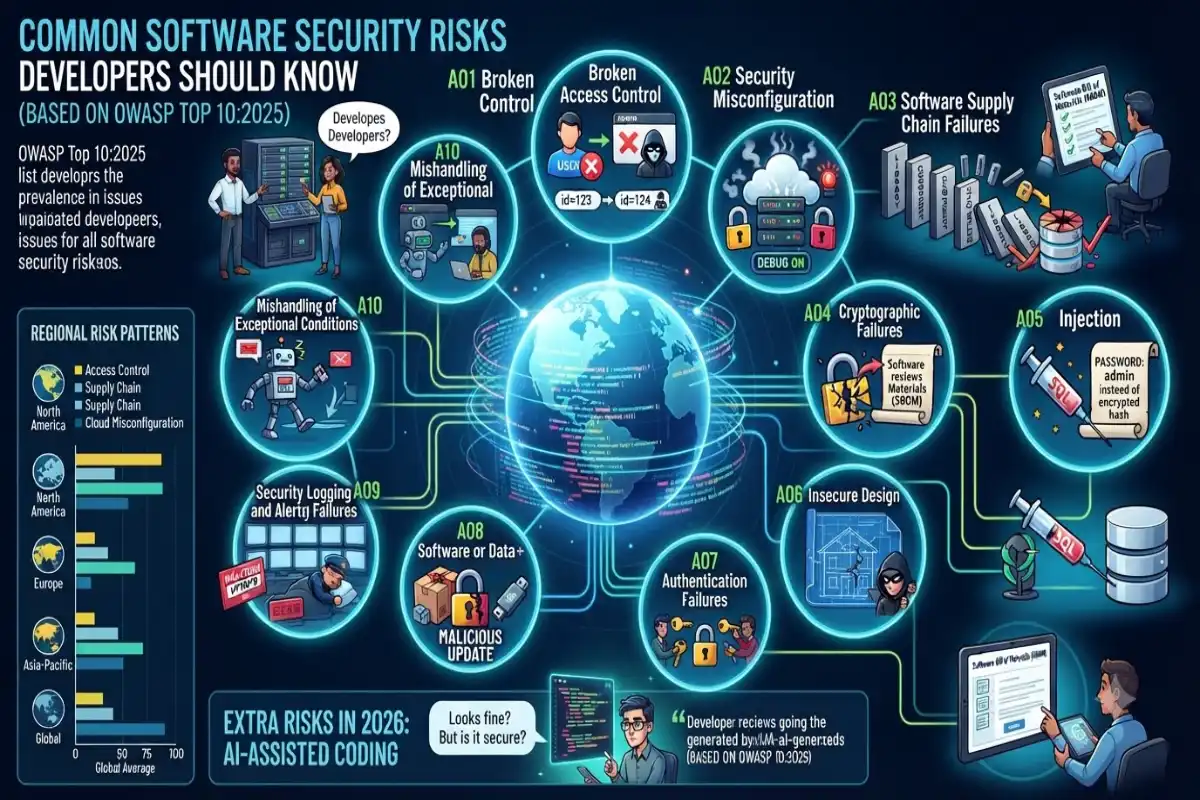
Every developer writes code that eventually faces the real world. Attackers look for the same weak spots over and over. Knowing the most common risks helps you catch problems early instead of fixing expensive breaches later. This guide covers the main risks based on the latest OWASP Top 10:2025 (still the current standard in 2026), plus related issues that keep showing up in real incidents.
What the OWASP Top 10 Actually Means
The OWASP Top 10 is a list of the most critical risks found in web applications and APIs. It is updated every few years using real vulnerability data, CVE trends, and feedback from security teams. The 2025 version (released late 2025) brought some important changes: Security Misconfiguration moved up sharply, Software Supply Chain Failures became its own major category, and Server-Side Request Forgery was folded into Broken Access Control.
Here is the current ranking:
| Rank | Risk | Short Description |
| A01 | Broken Access Control | Users can reach data or actions they should not |
| A02 | Security Misconfiguration | Insecure defaults, open services, missing hardening |
| A03 | Software Supply Chain Failures | Compromised packages, build pipelines, or updates |
| A04 | Cryptographic Failures | Weak or missing encryption that exposes data |
| A05 | Injection | Untrusted input treated as code or commands |
| A06 | Insecure Design | Security flaws built into the architecture |
| A07 | Authentication Failures | Weak login, session, or identity handling |
| A08 | Software or Data Integrity Failures | Code or data trusted without verification |
| A09 | Security Logging and Alerting Failures | Missing detection of security events |
| A10 | Mishandling of Exceptional Conditions | Errors that fail open instead of closed |
Broken Access Control – Still Number One
This risk appears in a large share of tested applications. A common example is changing a number in a URL or API call and seeing another user’s data. In multi-tenant systems the problem gets worse when one customer can access another customer’s records.
How it happens in practice
Developers forget to check permissions on every request. They rely only on the front-end to hide buttons or links. Attackers simply call the API directly.
What to do
Always enforce access checks on the server side. Use the principle of least privilege. Test with different user roles, including attempts to access other people’s resources.
Security Misconfiguration – The Fast Climber
Cloud platforms, containers, and microservices made configuration more complex. Default passwords, unnecessary open ports, verbose error messages, and missing security headers still appear often.
Real-world pattern
A development environment left running with debug mode enabled, or an S3 bucket set to public by mistake.
Practical fix
Use hardened base images, automated configuration scanners, and “secure by default” settings. Review every environment (dev, test, production) regularly.
Software Supply Chain Failures – The New Big Worry
Most applications contain large amounts of third-party code. A single compromised library, malicious update, or poisoned CI/CD pipeline can affect thousands of products. This category expanded in 2025 because real attacks moved from individual components to the entire build and distribution chain.
Year-wise shift
| Period | Main Focus | Typical Impact |
| 2021–2023 | Vulnerable and outdated components | Known CVEs in libraries |
| 2024–2025 | Broader supply-chain attacks | Compromised packages and pipelines |
| 2026 onward | AI-generated code + traditional dependencies | Harder-to-track origin of code |
Developers should maintain a Software Bill of Materials (SBOM), scan dependencies automatically, and verify the integrity of packages before use.
Injection and Cryptographic Failures
Injection still works when input is trusted too much. SQL injection is the classic case, but NoSQL, command injection, and expression-language injection also appear. Cross-site scripting is often grouped here as well.
Cryptographic failures include storing passwords in plain text, using outdated algorithms, or sending sensitive data without proper encryption. Even strong algorithms fail if keys are hard-coded or poorly managed.
Simple habits that help
- Use parameterized queries or prepared statements everywhere.
- Prefer established libraries for hashing and encryption.
- Never invent your own crypto.
Authentication Failures and Insecure Design
Weak password policies, missing multi-factor authentication, and poor session management still lead to account takeovers. Insecure design is deeper: the architecture itself lacks proper threat modeling. Features are added without asking “how could this be abused?”
Logging, Integrity, and Exception Handling
If you cannot detect an attack, you cannot respond. Missing logs or ignored alerts leave teams blind. Integrity failures happen when code or data is accepted without checking signatures or hashes. Poor exception handling can leak internal details or leave the system in an insecure state.
Country and Regional Patterns
Risk patterns vary somewhat by region because of different regulations, attack motivations, and development practices.
| Region | Commonly Reported Issues | Notes |
| North America | Access control, supply chain, cloud misconfiguration | High tool adoption but still frequent logic flaws |
| Europe | Misconfiguration, data exposure, logging gaps | Stronger regulatory pressure (CRA, GDPR) |
| Asia-Pacific | Injection, outdated components, rapid feature pressure | Fast growth in applications, varying maturity |
| Global average | Access control and misconfiguration dominate | Supply-chain risk rising everywhere |
Data from industry reports and breach analyses show that access-control problems remain the most frequent across most countries, while supply-chain incidents produce the highest impact when they succeed.
Extra Risks That Matter in 2026
AI-assisted coding (“vibe coding”) is introducing new problems. Generated code often misses authorization checks, hard-codes secrets, or lacks rate limiting. Developers who accept AI suggestions without careful review create the same classic risks at higher speed.
Cloud-native designs also increase the chance of Server-Side Request Forgery and tenant isolation failures.
Practical Advice for Everyday Work
Start with the risks that appear most often: access control and configuration. Add automated scanners for dependencies and known vulnerabilities into your normal build process. Review authentication and session handling carefully. Treat third-party code and AI-generated code with the same skepticism you would apply to untrusted input.
Security is not a separate phase. It is part of writing reliable software. When you understand these common risks and build habits around them, you reduce the chance that a small oversight becomes a large incident. The list will keep evolving, but the underlying idea stays the same: assume attackers will try the obvious paths, and close those paths before they do.
