

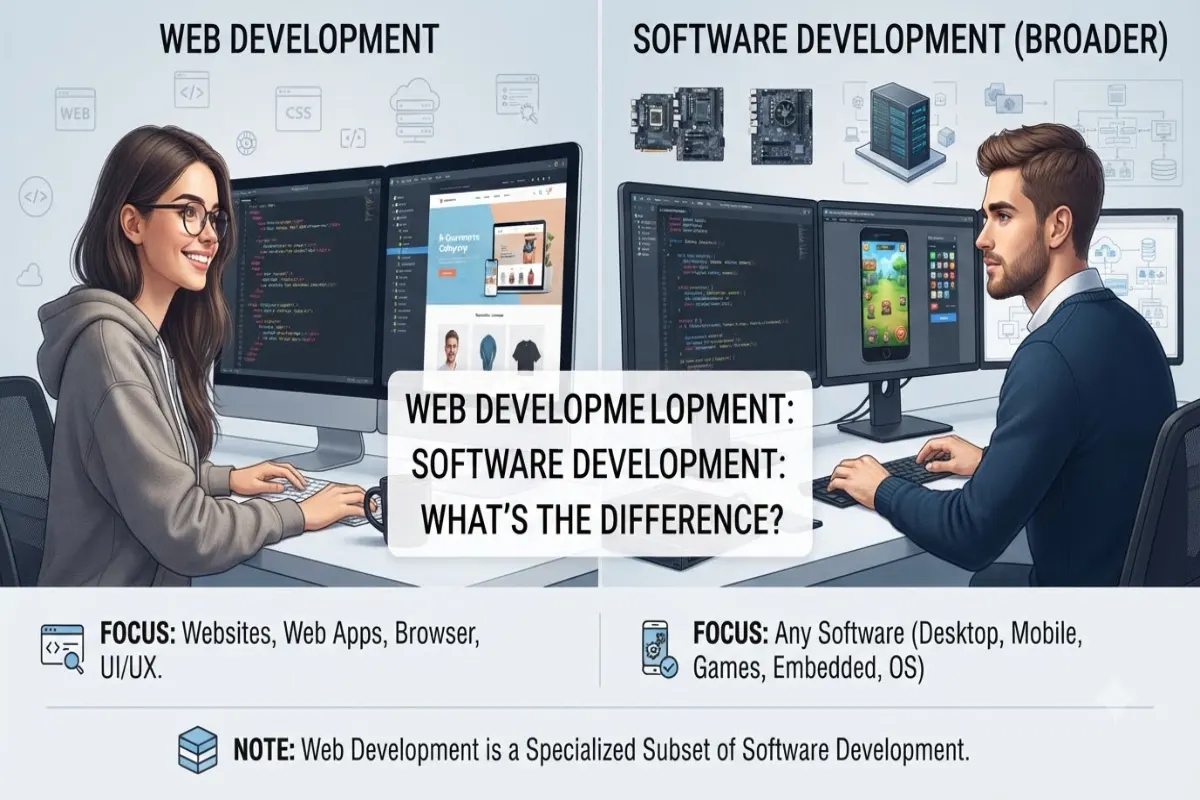
A lot of people use the terms “web development” and “software development” as if they mean the same thing. They’re related, but they’re not identical. Understanding the difference helps if you’re starting out, looking at job listings, or trying to decide what skills to learn first.
Here’s a clear, practical breakdown.
What Is Software Development?
Software development is the broad umbrella term. It covers the entire process of creating any kind of software — planning, designing, writing code, testing, deploying, and maintaining programs that run on computers, phones, servers, or other devices.
Software can be:
- Desktop applications (like Microsoft Word or Photoshop)
- Mobile apps
- Games
- Embedded systems (code inside cars, medical devices, or smart appliances)
- Enterprise tools used inside companies
- Cloud services
- And yes, websites and web applications
So software development is the big category. It includes many specializations.
What Is Web Development?
Web development is one specific type of software development. It focuses on building websites and web applications that run in a browser (Chrome, Safari, Firefox, etc.).
When you open a website, book a flight online, use Google Docs in your browser, or check your bank account online, you’re using the result of web development.
Web development usually splits into:
- Front-end — Everything the user sees and interacts with (layout, buttons, animations). Built with HTML, CSS, and JavaScript (often with tools like React or Vue).
- Back-end — The server-side logic, databases, and APIs that power the site. Common technologies include Node.js, Python, Java, PHP, or Ruby.
- Full-stack — Developers who work on both the front-end and back-end.
Web development is still software development. It’s just focused on the web platform.
Key Differences Side by Side
| Aspect | Web Development | Software Development (broader) |
| Scope | Websites and web apps that run in browsers | Any software (web, mobile, desktop, embedded, etc.) |
| Platforms | Browsers on any device | Computers, phones, servers, hardware devices |
| Common languages | HTML, CSS, JavaScript, plus back-end languages | Many: Python, Java, C#, C++, JavaScript, Swift, etc. |
| Deployment | Usually online servers / cloud | App stores, desktop installers, devices, servers |
| User access | Through a URL in a browser | Install app, open program, or use device |
| Typical focus | User interfaces, responsiveness, SEO, APIs | Varies widely by specialty |
| Learning curve for beginners | Often easier to start and see results fast | Can be steeper depending on the specialty |
Overlap in 2026
The line has blurred a lot. Many “software developer” job postings these days are actually for web or full-stack roles. Modern web applications are complex pieces of software. A good full-stack web developer is writing real software — just targeted at the browser and servers that support it.
At the same time, pure software development roles still exist that have little or nothing to do with the web:
- Building desktop tools for Windows or macOS
- Writing code for embedded systems or IoT devices
- Developing video games with Unity or Unreal
- Creating system-level software or operating system components
- Working on mobile apps that are fully native (not web-based)
So while web development is a major part of software development today, it doesn’t cover everything.
Skills Comparison
Web developers typically need:
- Strong knowledge of HTML, CSS, and JavaScript
- Understanding of how browsers work
- Front-end frameworks (React, Vue, Angular, etc.)
- Back-end basics and databases if full-stack
- Responsive design and accessibility
- Version control (Git)
- Basic deployment and hosting knowledge
Software developers (in general) may need:
- Deeper computer science fundamentals (data structures, algorithms, system design)
- Different languages depending on the domain (C++ for performance-critical work, Swift/Kotlin for mobile, Python for data/AI, etc.)
- Knowledge of operating systems, memory management, or hardware in some cases
- Testing, architecture, and long-term maintenance skills across different environments
Many skills transfer. Learning web development teaches you core programming concepts, problem-solving, and how to work with tools that almost every software job uses (Git, debugging, collaboration). From there you can expand into other areas.
Career and Job Market Perspective
In job listings you’ll see both titles. Sometimes “Software Developer” or “Software Engineer” is used for web roles. Other times companies are more specific: “Front-End Developer,” “Full-Stack Web Developer,” “Mobile Software Engineer,” etc.
Web development roles are very common and accessible for beginners. You can build a portfolio of real projects relatively quickly and show them online. Broader software development roles, especially systems, embedded, or specialized enterprise work, may require more formal experience or deeper technical knowledge.
Salaries vary by location, experience, and exact specialty. In many markets, general software development roles (especially those requiring stronger computer science foundations or specialized skills) tend to average higher than pure front-end web roles, but strong full-stack and back-end web developers can earn very well too.
Which One Should You Learn First?
If you’re a complete beginner, web development is often the practical starting point:
- Free resources are abundant
- You can see results in the browser immediately
- The skills are widely useful
- Many jobs are available
Once you understand programming fundamentals through web work, you can decide whether to go deeper into web technologies or branch into mobile, desktop, data, embedded systems, or other areas of software development.
If you already know you want to build games, work with hardware, or create complex desktop tools, you might start with languages and concepts more suited to those domains. But even then, some web knowledge is useful because so many tools and documentation live on the web.
Common Confusion Points
- “Is a web developer a software developer?”
Yes. Web development is a subset of software development. - “Do software developers only write complex system code?”
No. Many software developers spend their days building web applications or mobile apps. - “Is web development easier?”
The entry barrier is often lower, and feedback is faster. But building large, secure, high-performance web applications is still serious engineering work. - “Will AI replace one more than the other?”
AI coding tools are used in both. They help with writing and testing code, but understanding requirements, architecture, and quality still requires human judgment in both fields.
Summary
Software development is the overall field of creating software of any kind.
Web development is the specialized part of that field focused on websites and web applications that run in browsers.
In everyday conversation and many job markets in 2026, the terms overlap a lot because so much modern software is delivered through the web. Still, the distinction is useful when you’re choosing what to study or reading job descriptions.
If you want a practical way in, start with web development. You’ll learn real programming skills, build visible projects, and keep the door open to the wider world of software development later.
